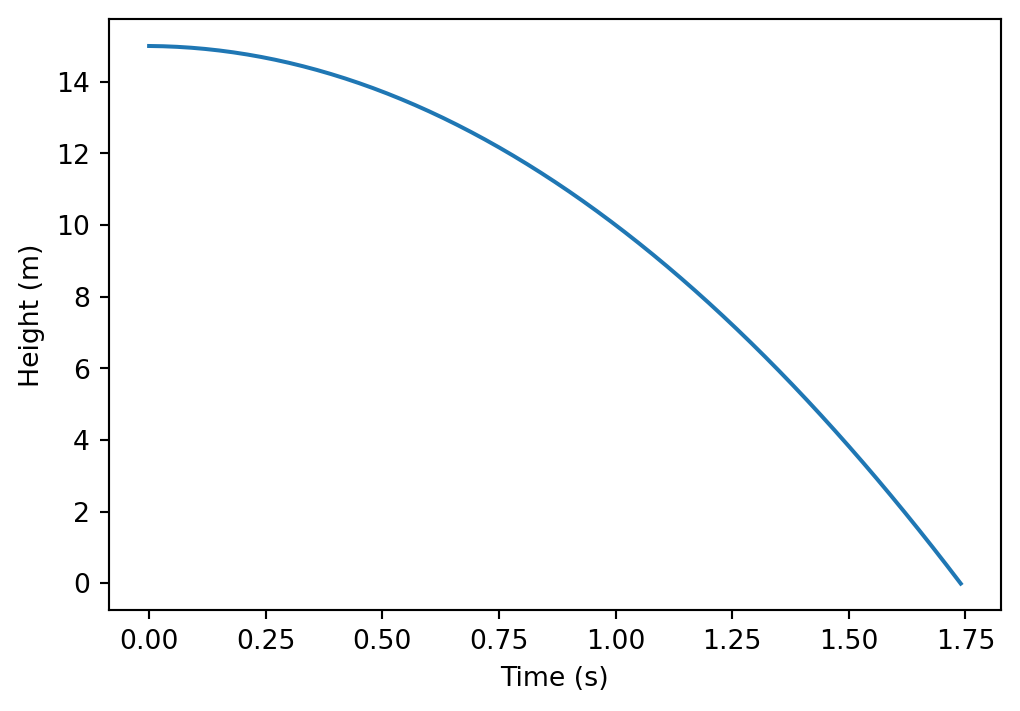
A simulation is a representation of a phenomenon or a process, usually over time. For example, we could define a ball as a circle at rest 5 m above the ground, and then simulate that ball falling to the ground by finding its position every 0.01 seconds, as it accelerates, until it hits the ground.
Given a model of a phenomenon, we can simulate that phenomenon by defining an initial state and then running the simulation for some fixed amount of time, or until some specific requirement is reached.
18.1 Simulating Gravity
Let’s simulate a ball falling from a height of 5 meters.
import matplotlib.pyplot as pltimport numpy as np## Initial conditions y =15# Initial height vy =0# Initial vertical velocitya =-9.8# Initial acceleration (constant)dt =0.01# Time step sizetimes = [0]heights = [y]## Run simulation until ball reaches ground while y >0: vy = vy + a*dt y = y + vy*dt + (1/2) * a * dt**2 times.append(times[-1]+dt) heights.append(y)## Visualize the results plt.plot(times, heights) plt.xlabel('Time (s)')plt.ylabel('Height (m)')plt.show()